About the Project
KI Coding grew from my idea of bringing the learning experience closer to real software development. Instead of completing disconnected coding exercises, learners gradually build complete applications with multiple files, an authentic project structure, and progress that is stored across learning sessions.
My goal was not to build another online editor with an AI chat window. I wanted to create a complete learning platform in which the workspace, sandbox, progress engine, adaptive learning system, and AI tutor work together as one coherent product.
My Vision
Many learning platforms teach programming through short exercises that can be completed within a few minutes. Real software, however, develops over time. Files are added, bugs are analyzed, existing code is refactored, and new features must fit into a growing architecture.
KI Coding is designed to recreate that experience in an educational environment. The platform should support learners over a longer period of time, understand their current knowledge, and help them develop not only syntax skills, but also debugging, structured problem-solving, and software architecture.
Core Features
Project-Based Learning
Learners build complete applications with files, folders, tasks, and progressive milestones rather than working only on isolated code snippets.
Adaptive Learning Engine
The learning system evaluates progress, completed tasks, used hints, code runs, and acquired skills to adapt the experience to each learner's current level.
Context-Aware AI Tutor
The tutor understands the active project, open files, current tasks, milestones, compiler errors, console output, learner profile, and previous conversations.
Professional Workspace
A multi-file workspace with Monaco Editor, file tree, tabs, autosave, project management, and an integrated console provides an IDE-like development experience.
Docker Sandbox
Kotlin and Python projects can be executed directly from the browser inside isolated containers with resource limits, timeouts, and filesystem protection.
Automatic Validation
Tasks are not evaluated by AI alone. The platform uses reproducible file, source-code, regular-expression, and output checks combined with real program execution.
AI Project Generator
From a project idea, the platform creates structured learning projects containing domain models, services, files, milestones, tasks, and technical validation rules.
AI Command Center
AI providers, models, and platform services are managed centrally. The tutor, generator, and analysis features can be routed independently to different providers.
Technology & Architecture
The backend is built with Kotlin and Ktor, using PostgreSQL as its central persistence layer. The frontend is implemented with Next.js, React, and TypeScript. The platform is divided into clear domains such as authentication, projects, tutoring, learning, billing, templates, and AI administration.
New AI providers and services can be integrated without rebuilding the tutor or project generator. This separation was important to me because it keeps the platform maintainable and expandable over the long term.
Intelligent Learning Support
The AI tutor receives far more than a single user question. It works with a structured project context that can include the current task, active file, project files, compiler errors, console output, milestones, skills, and previous learning progress.
Tutor policies and guardrails prevent the learning process from being bypassed through complete solution dumps. Assistance is delivered progressively, from a small hint to a concrete next step and, when appropriate, a more detailed conceptual explanation.
Project & Template System
Learning projects can be created from validated templates or generated with AI. The generation pipeline separates domain planning, curriculum design, validation, and technical template construction.
This allows the platform to create consistent Kotlin and Python projects containing models, services, tasks, skills, starter files, and automatic checks. Generated projects belong to the individual user and remain available after logout, reload, and future login sessions.
Learning Progress & Analytics
The platform stores completed tasks, started and completed milestones, skills, tutor usage, requested hints, code runs, and other learning events. These records form individual learner profiles and measurable progress data.
The data is not used only for visual statistics. It provides the basis for adaptive recommendations and allows the tutor to consider previous difficulties and acquired skills when generating future support.
AI Management & Usage Control
The AI Command Center can manage providers such as Ollama, OpenAI, Anthropic, Gemini, and other compatible services. Provider, model, activation state, and technical parameters can be configured independently for every AI-powered feature.
Requests, token usage, response times, errors, fallbacks, and estimated costs are also recorded. This makes it possible to understand which parts of the platform consume AI resources and how operational costs are distributed.
Product Interface
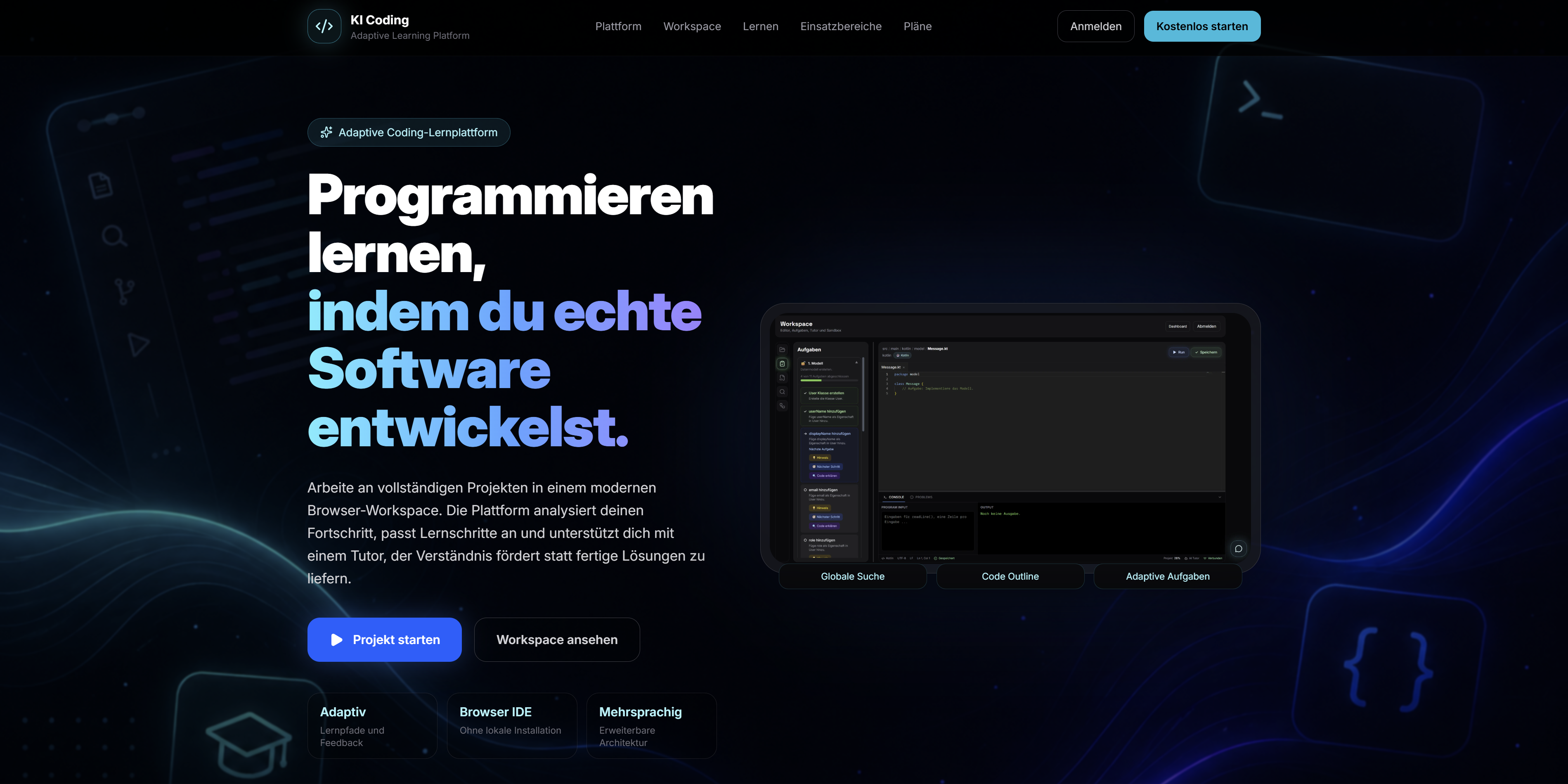
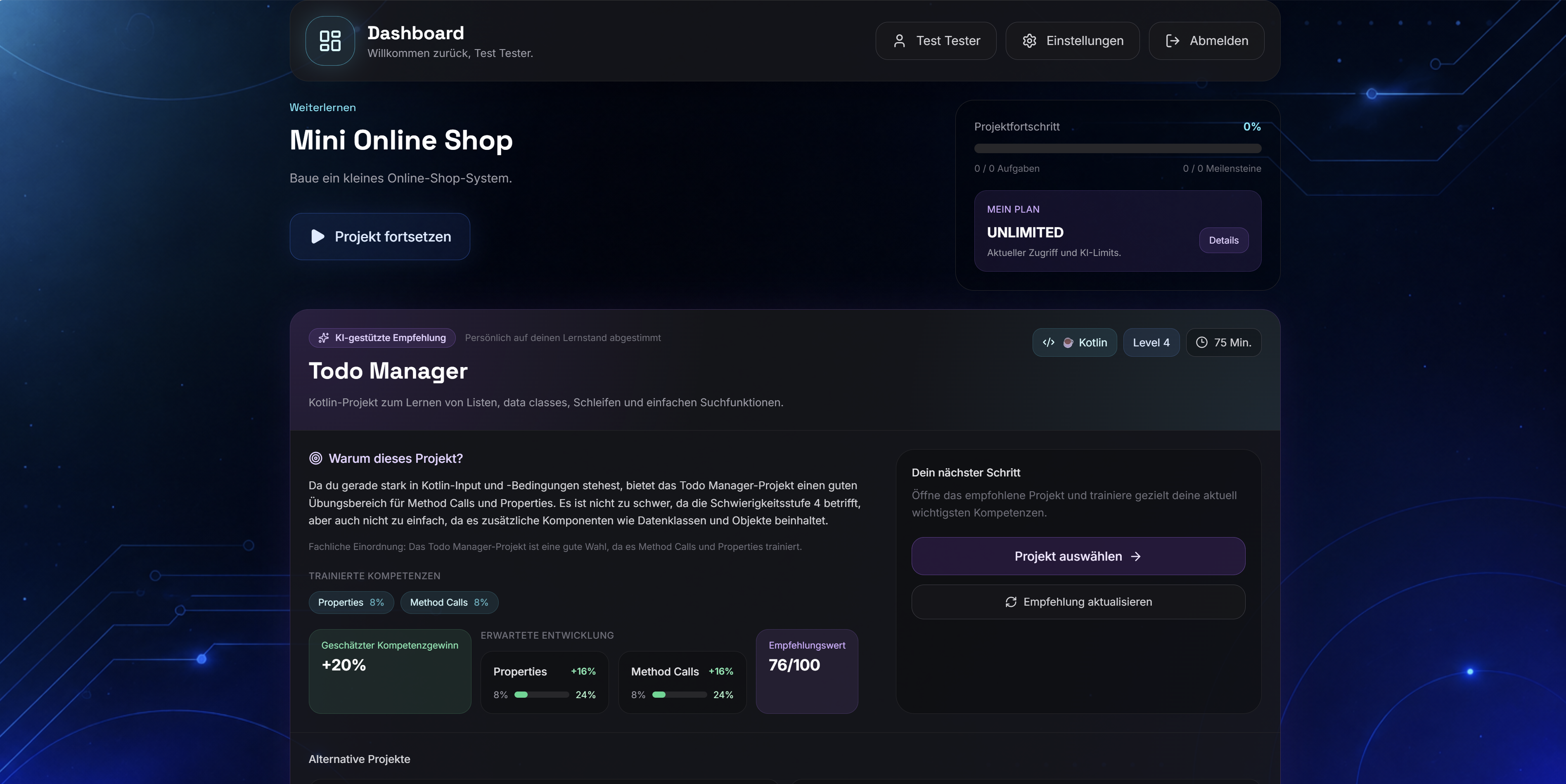
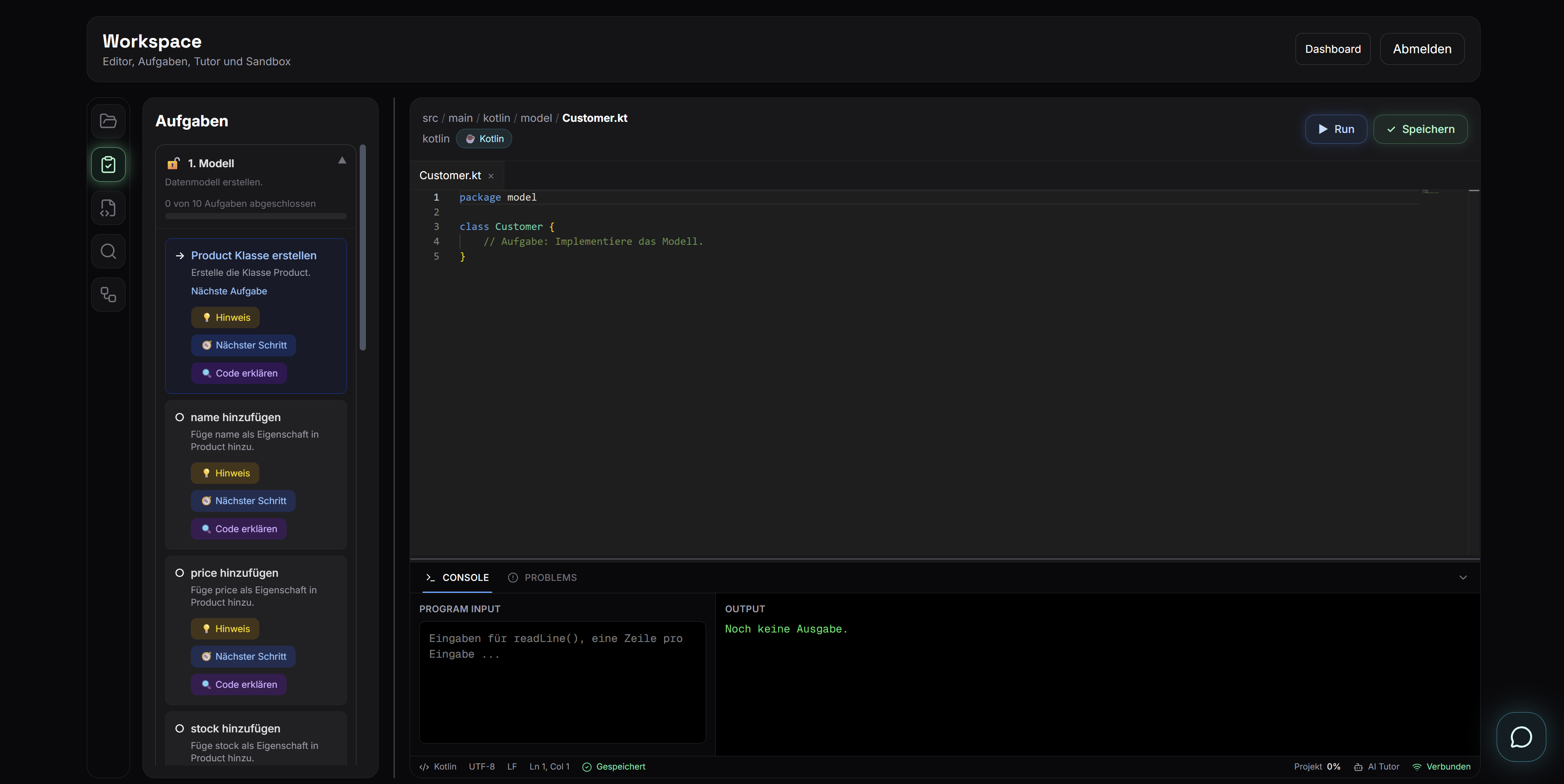
Technical Challenges
The main challenge was connecting many interdependent features into one consistent product. Authentication, roles, persistent projects, file management, sandbox execution, automatic validation, tutor memory, billing, and adaptive learning logic all had to work reliably together.
Finding the right balance between deterministic software logic and generative AI was especially important. Technical correctness should never depend entirely on a language model. The platform therefore performs objective checks itself, while AI is used for explanations, hints, contextual analysis, and educational support.
What I Learned
During development, I learned that a strong AI learning platform cannot be created by adding a powerful language model alone. It requires a clear architecture, reliable persistence, reproducible validation, and carefully structured context.
Only the combination of traditional software engineering, artificial intelligence, and educational product logic creates an environment that supports learners without taking away the thinking and problem-solving that make learning meaningful.
Current Status
KI Coding has grown from an early workspace prototype into a broad full-stack platform. Authentication, project management, learner profiles, AI tutoring, sandbox execution, Template Studio, project generation, billing, learning analytics, and centralized AI administration are already implemented as connected systems.
The current focus is on improving adaptive learning strategies, the quality of generated projects, tutor support, and the preparation of the platform for a stable production environment.